
Strains, often called pulled muscles, are stretched or torn muscles or tendons. They occur most often in the shoulders, neck, abdominal area, back, hips, and legs. “The injury often happens when you need to exert force with speed, like in sports such as tennis, golf, and running,” . “Typically, the injury occurs when the muscle contracts at the same time it is being lengthened.”
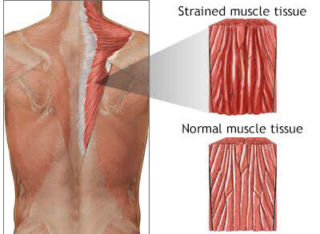
Strains are graded from 1 to 3, depending on the severity. “Muscles that are fatigued, overused, or not warmed up are at increased risk of a strain”. An imbalance between weak and strong muscles—for example, a strong quadriceps (front of the thigh) paired with weaker hamstrings (back of the thigh)—can also cause a strain.
A muscle tear or muscle strain happens when your muscle is overstretched. Muscle strains can happen in varying degrees– (1 through 3) from a few muscle fibers being torn to nearly all of your muscle fibers tearing.
Muscle strains typically occur when your muscle is being overloaded with too much weight or your muscle has reached its limit. Common reasons you may have a muscle injury include:
When a muscle tear occurs, the entire structure of your muscle is affected including damage to your blood vessels. Once these are damaged, they’ll bleed into the surrounding muscle fibers and tissues leading to swelling and bruising.
If you’ve suffered a major muscle sprain you may experience:
If it’s a minor sprain, you may have slight pain and stiffness but there may not be as much swelling or bruising.
More than 90% of cramps happen in the hamstrings, quadriceps, or calves. The symptoms are unmistakable: sudden, involuntary, and painful contractions. Cramps are often linked to fatigue, exercising in hot and humid weather, prolonged overuse, or dehydration. Another possible cause is electrolyte deficiency. People who take diuretics or have kidney disease can develop an electrolyte imbalance, and are at a higher risk of cramps
A Migraine is a condition involving severe headache which is recurring. Migraines are mainly triggered by hormonal changes, emotional triggers, dietary factors, and medications.
When cavities around the human nasal passage experience inflammation, it’s called Sinusitis. The symptoms are facial pain, headache, runny nose, and nasal congestion.
The sense of our surrounding spinning, rocking, or rotating when the head is moved too quickly causes Vertigo. Vertigo may cause nausea, dizziness, and blurry eyes.
Bell’s Palsy is the severe weakening of the facial muscles. It occurs on one side of the face and can also affect the sense of taste, saliva, and production of tears.
Neck pain and stiffness is defined by soreness in the neck region. Under this condition, it gets difficult to move the neck. The condition can be accompanied by shoulder pain, arm pain, headache etc.
The condition affects the human spinal column and causes inflammation between the vertebrae. The condition attacks the muscles which connect bones to connective tissues.
Spasm is a painful condition in which muscles are clenched tightly. It can be caused by stress, overexercise, etc. Spasms are involuntary and forceful.
A person suffering from adhesive capsulitis experiences a limited shoulder movement. It’s more common in people with diabetes. It’s also called painful stiff shoulder and Periarthritis.
The human shoulder is stabilized by a group of four muscles and tendons called the rotator cuff. Overuse of the rotator cuff can cause mild to severe injury. Overuse of shoulder muscles can also cause rotator cuff injuries.
Most common in adults, Bursitis is a condition involving severe inflammation of the bursa sac region. As we age, tendons become weak and can’t handle physical stress well. When a joint is used too much or there is repeated pressure on the area, Bursitis is caused.
A shoulder dislocate happens when the upper arm bone decouples from the shoulder blade socket. The condition requires prompt medical attention and causes swelling, pain, and inability to move the dislocated shoulder.
It’s a process of re-establishing the muscle strength and aiding joint motion to make it fully functional. It can go on for months and in some cases up to a year.
CTS or Carpal Tunnel Syndrome is tingling in hands and arms. The condition is caused by a pinched nerve in the wrist. CTS causes numbness and pain.
De Quervain is a painful condition that affects the thumb side of a wrist and causes inflammation in the tendons. Repetitive wrist movements are the primary causes of the syndrome.
It’s a condition involving a non-functional or stuck finger. Trigger finger is also referred to as ‘Stenosing tenosynovitis’. Under this, you have no sensory control of the finger.
Arthritic Joints is swelling of one or more body joints. The condition causes severe swelling. Muscle stiffness is the primary cause of this condition. Osteoarthritis is the most common type
Arthritis is a condition in which flexible tissues around the end of the bones wear off. The condition worsens over time and causes long-term joint pain in the knees, lower back etc
Muscle strains, bruises, sprains, tears, and broken bones are some of the common sports injuries. These should be attended immediately to ensure the physical wellness of the human body.
Knee pain is a product of a torn cartilage, injury, or ruptured muscle. Heavy physical exercise is the primary cause of knee pain in adults.
Arthritis in knees causes inflammation in joints. Swelling and stiffness are the primary causes. Some of the most common symptoms are cracking or popping sounds.
Ligament injuries are spread on different grades of sprains. It causes the knee to pop and buckle. There are three major grades of ligament injuries varying on normal to severe joint instability.
It is a type of damage that happens under the kneecap. The cartilage present under the kneecap absorbs the shock. When the knee is overused the condition may develop over time.
The limited or difficult motion of a joint is caused by stiffness in muscles. The condition worsens with age and can cause underlying pain and flare.
Knee replacement can provide relief, improved motion, and better quality of life to people. Post-surgery, it takes three to six weeks to get the knee back to normal activities.
The ankle is the junction point for three tissues, tendon, ligament, and bone. Ankle sprain and strain varies on the degree of damage and can be treated with the right care.
It is the inflammation in the thick band of tissues that are responsible for connecting toes to the heel bone. Plantar Fasciitis is caused by prolonged standing, extreme running, or jumping.
The largest tendon in the human body is Achilles. The tendon degenerates when calf muscles are tightened. Patients might experience a bump right below the heel bone.
It is a common condition that is caused by repetitive stress or pounding on the heel area. In most cases, the pain occurs in the front of the heel.
Injury to a muscle or ligament sprain is the primary cause of lower back pain. Lack of regular exercise is the most common cause of the condition. It may cause a ruptured disk or arthritis.
It is the emerging pain from the lower back which goes down right to one or both legs. Sciatica typically affects only one side of the human body.
Spinal disks are made of a tough outer layer and a soft inner core. When normal changes in spinal disks take place over time, DDD can emerge.
A herniated disk irritates a nearby nerve which causes swelling, numbness, and weakness in the leg or arm. The condition is also called a slipped disk or ruptured disk.
The condition prevails around the thoracic vertebrae around the lower back. Herniated disks, fractures, and sudden injuries can cause the condition to worsen over time.
It is a painful condition in which the softcore of the spinal disc seeps through crack or bulge exterior spinal casing. Depending on the degree of slippage, the pain and side-effects vary.
Wear and tear to the human spine causes a type of arthritis called Spondylosis. The condition worsens with age and may cause severe muscle spasms and pain.
It generally happens before puberty. Children often develop deformities in the spine which might cause partial to the full disability with time, if not treated.
Numbness, pain, and tingling sensations are the primary symptoms of this syndrome. The disorder involves inflammation of the sciatic nerve caused by piriformis muscles.
Forceful wrist and finger motion resulting from excessive physical stress cause Golfer’s Elbow. Hands and wrist might feel weak while the elbow remains stiff.